Frederick Clawson
The Dark HalfFrederick Clawson is a law student and aspiring beneficiary of the story behind Thad Beaumont’s pseudonym, George Stark. He tries to profit from Beaumont’s public disclosure, but the story he expects to control instead becomes tied to his murder in Washington, D.C.—a crime that deepens the investigation and brings Alan Pangborn to Beaumont’s door.
Identity and ambitions
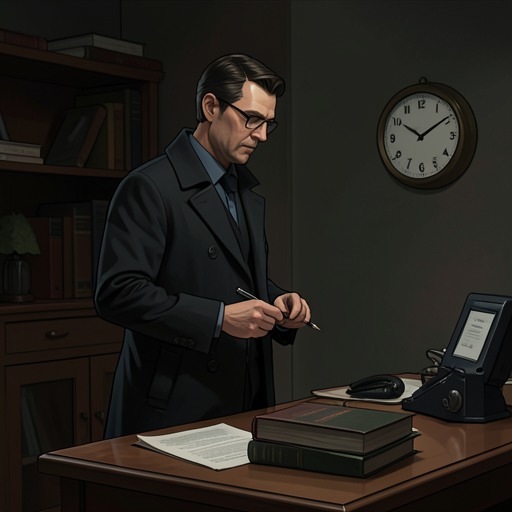
Clawson is characterized less by professional standing than by the gap between his aspirations and his resources. He is a law student living in a third-floor apartment, and he falls behind on rent four times in a row. He persuades his landlady, Dodie Eberhart, to tolerate the arrears by claiming that money is coming in. The novel presents him as a would-be operator still short of the means and standing he imagines for himself.
His interest in George Stark is not casual. Eberhart is a devoted reader of hard-boiled crime fiction, and the first time she visits to collect rent she finds Clawson surrounded by notes and Stark novels. She asks whether the books are required reading for a career at the bar. Her question links his legal ambitions to his enthusiasm for a fictional criminal world, while establishing that he knows the Stark books closely enough for the pen name to matter to him.
The disclosure and the attempted payoff
After Thad decides to reveal that he wrote as George Stark, his agent, Rick Cowley, gives the story to Louise Booker at Publishers Weekly with Thad’s approval. Jerry Harkavay of the Associated Press’s Waterville staff then spreads it more widely. The coverage is incomplete: Thad refuses to give Clawson so much as a mention, and he insists that Clawson is not the story but the person forcing him to tell it. The distinction matters. Clawson has helped precipitate the disclosure, but the public account does not grant him the central place he wants.
Clawson believes the story will never be printed and expects it to make him moderately wealthy instead. A copy of People magazine featuring the Beaumont–Stark story later appears at the scene of his death, making the failed expectation visible: the story is in print, but Clawson has not profited from it. His confidence in a lucrative outcome is overturned, and his attempt to control the disclosure ends not in public prominence but in murder.
Death and discovery
George Stark kills Clawson in Washington, D.C. When Alan Pangborn visits Thad and Liz Beaumont, he identifies Clawson as the victim of a second murder and watches Liz react at the name. Pangborn knows the Beaumonts recognize it; he is seeking Thad’s help, not announcing an arrest. Clawson’s death therefore changes the stakes of the conversation: the scandal surrounding the pen name is now part of a series of killings that the sheriff cannot explain.
The discovery is rendered through Eberhart’s attention to the apartment’s objects. She sees the two beer bottles, the ashtray, and the push-pins scattered across the coffee table, along with the People magazine story about the Beaumonts and Stark. These details place the failed transaction and the public disclosure in the same room. The magazine is no longer simply evidence of a story Clawson hoped to exploit; it is part of the scene that demonstrates how completely that plan has collapsed.
Connection to the crime-fiction world
Clawson’s reading connects him to the hard-boiled conventions associated with Stark’s books. In an interview, Beaumont explains that George Stark’s crime-fiction model drew on Richard Stark’s Parker novels: Parker is a professional thief with few interests beyond robbery, and Beaumont compares him to a machine driven by a single goal. He identifies Alexis Machine, the principal character of the first and last George Stark novels, as a related figure. Clawson’s fascination with Stark’s books places him near this fictional world, but the novel does not establish that he shares its characters’ methods or motives beyond seeking money from the story.
That boundary matters to the larger design. The crime novels are discussed as constructed works with recognizable genre patterns, while the murders belong to the real world of the investigation. Clawson’s failed effort to monetize the disclosure, followed by his death at Stark’s hands, makes the boundary between literary notoriety and actual violence dangerously unstable without making Clawson himself the embodiment of the fictional criminal code.